
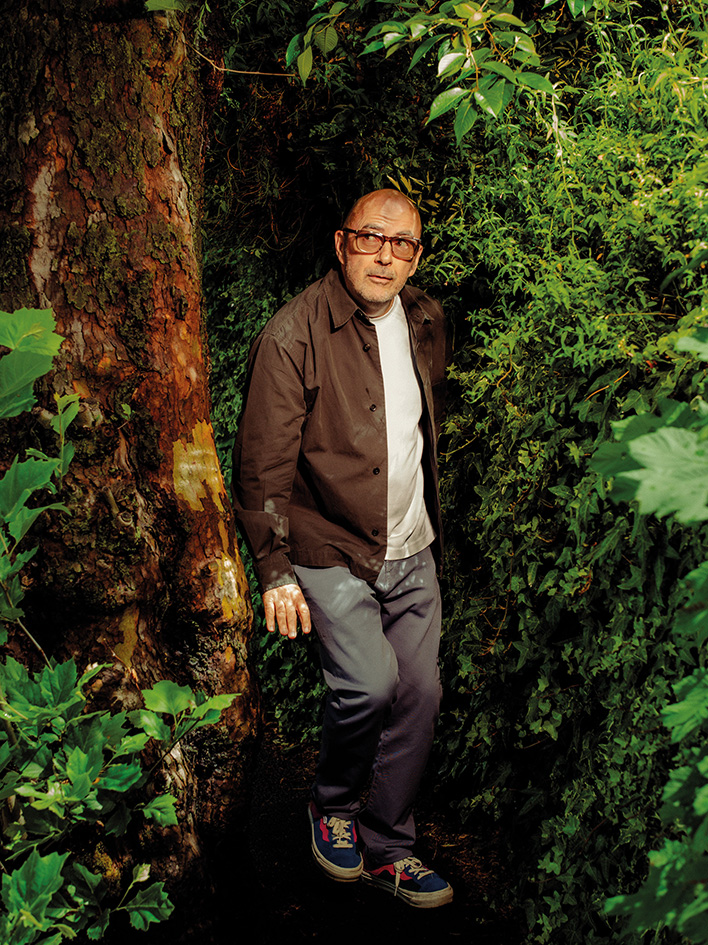
On the one hand, James Richardson has enjoyed a busy and varied presenting career. He has worked for BT, ESPN and the BBC, and hosted coverage of cycling, sumo wrestling, model-railway building, and – for over 16 years – World’s Strongest Man, filmed in the spring but broadcast at Christmas as sunny entertainment.
Despite the variety – and his appeal – Richardson is associated most with a programme that started when he was 26 years old – Gazzetta Football Italia. It has been endlessly invoked through variations of an image of Richardson, looking “quite cool” and “quirky,” in Rio Ferdinand’s phrase, sitting cross-legged with a newspaper, a coffee cup and a pastry. In 1996, the Evening Standard crowned Gazzetta, then four years into its decade-long run, one of the cult TV shows of the era, along with The X-Files and My So-Called Life, and described Richardson as a “football presenter like no other” – “a balding Rome-settled schmoozer… living the Nineties café dream”.
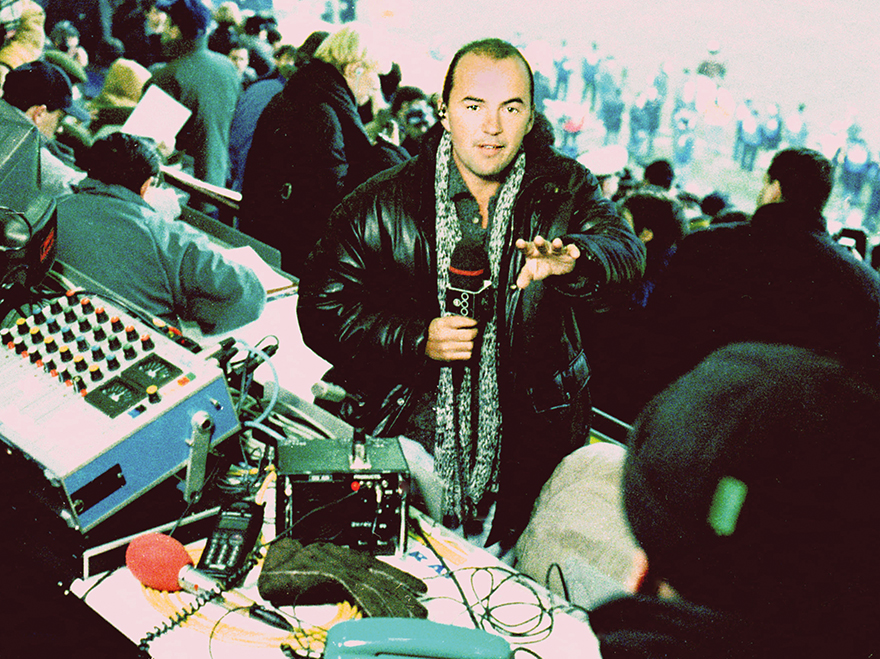
Episodes of Gazzetta, which appeared on Channel 4 on Saturday mornings throughout the football season, began with footage of on-pitch skills and celebrations set to a voice rapping “campionato di calcio Italiano” (Italian football championship) and a commentator crying out “golazzo” (great goal). Then Richardson would introduce a reel of “recent” – though by contemporary standards, ancient – highlights, run through the stories from Italy’s specialist press and look ahead to the match he would be presenting the following afternoon.
As well as interviewing players and managers in a traditional, sober format, Richardson went CD shopping with the Parma team, induced the Juventus winger Attilio Lombardo to dance the lambada and received visits from the singers Elvis Costello and Bryan Adams.

During a recent encounter, Richardson, now 60, credited the programme’s existence to shifting attitudes. “For so long there had been embarrassment and even shame about English football,” he tells me, referring to hooliganism, stadium disasters and stodgy tactics. That changed in 1990, when the World Cup was held in Italy. Watching the BBC’s opening titles, with Pavarotti singing Puccini’s “Nessun dorma”, Richardson thought it was “madness”. Then he succumbed. “It was a food you thought you never enjoyed,” he said. “Someone cooks it for you in a different way…”
As it turned out, England reached the semi-finals in style, then were knocked out on penalties – “Heartbreak which couldn’t have been more English. They were glorious failures. It cemented their place in our hearts.” As Salman Rushdie put it, football “got to us as never before”.
Gazzetta was intended as a sequel to the coverage of Italia ’90. While Sky was obsessing over the Premier League, Channel 4 picked up the rights to its Italian counterpart, Serie A, bringing its football to a mainstream British audience. “It was a no-brainer, really,” Richardson told me. The stadiums already had an emotional resonance for viewers, and the Italian league – “not just the best but far and away the best” – featured many of the players from the World Cup, notably Paul Gascoigne (“Gazza”), who had moved from Tottenham Hotspur to the Rome club Lazio.
The show began in September 1992. The first words of praise that Richardson received were from Nick Hornby, whose debut book, Fever Pitch, about the agonies of supporting Arsenal, was reviewed the same weekend. Soon afterwards, Alex Ferguson handed a debut to 17-year-old Manchester United protégé, David Beckham.
Where Fever Pitch helped align fandom with male vulnerability, and Beckham’s fame brought the domestic game into the realm of celebrity culture, Gazzetta revealed the educative or anthropological possibilities of an international perspective. The journalist Michael Cox said it was “just cool to see that things were done differently. We always had a minute’s silence, they always had a minute’s applause.”
Gazzetta functioned as a travel programme – in the words of the Italy football correspondent James Horncastle, “an Englishman selling a lifestyle as much as a league”. Tom Williams, a specialist in French football, said that Richardson was always “dialled in to an awareness that there was an appetite for football coverage that wasn’t just about what happened on the pitch”. The former England striker Peter Crouch, meanwhile, in a swooning reminiscence – complete with a knowing description of Richardson’s presenting style – recalled becoming “so obsessed with the whole culture”.
It remains unique in this regard. Cox told me that “for all the foreign coverage we get now, we don’t have anything that takes the cities to us. I wanted to visit Florence because of James sitting outside coffee shops, or whatever. I know that’s a bit of a cliché now.” Cox added that Richardson doesn’t really understand the show’s “cultural significance”: “He wasn’t here!” Blogs are full of commenters similarly convinced – as one put it – that “this guy” will never “fully appreciate the impact he had on us”.
Growing up, James Richardson cared more about music and movies than football. He was educated at boarding schools, including Caldicott, where Nick Clegg was in the year below. Richardson’s parents lived in Lebanon, then Kuwait, before moving to London. I asked him what his father, who trained an engineer, did for a living. He said he wasn’t “entirely sure” but that “he was many things and generally wildly successful at them”. Richardson studied English at Goldsmiths, then found a job in television. He also fell in love with a girl from Rome.
The original plan for Gazzetta was that Richardson would present a few sections and work as a producer, while Gazza, now based in Rome, would be the presenter – the show’s title was in part a play on Gascoigne’s nickname. (“That took me about four years to work out.”)
To Richardson, getting a job on a football programme in the city where his girlfriend lived seemed “kind of miraculous”. Then came the real miracle. Gazza stopped showing up, and Richardson filled in. He thought he would be back in London “in a couple of months at the most”.
What happened next has been the subject of a documentary, a book and a podcast, all called Golazzo, and a clothing line – “me, still with hair, holding a coffee”. Richardson has proved to be the rare example of an advocate who becomes indistinguishable from their cause, the way that Kenneth Tynan, who introduced postwar theatre to readers of the Observer, now constitutes a central part of that moment.
In football lore, Richardson’s time in Rome is cited more than Gazza’s. The sports journalist James Horncastle argued that “as much as people reminisce about watching ‘Beppe’ Signori and George Weah, they tuned in for James. He was the star.”
For the generation of football fans who are now aged between 35 and 50, the thought of Richardson produces a feeling of warmth and delight. (Rio Ferdinand once started an interview by saying that Richardson’s introduction “just takes me back to my youth”.) When he was tapped up to present matches for BBC Scotland, the executive responsible explained: “I’m 42, so I loved the Channel 4 show.”
Missing from the visual shorthand for Richardson’s early career is the crucial element – his voice. When you’re speaking, “you can do what you want with words”. He is a specialist in tone shifts, transitions and slaloming, sing-songy intonations, with a liberal use of italic and underline – the ideal vehicle for his groan-risking wordplay and acts of spry pedantry.
It was a style – virtuoso informality, the higher banter – also exhibited by Chris Evans and Mark Lamarr, who began appearing on another Channel 4 morning show, The Big Breakfast, 22 days after Gazzetta first aired. Richardson suggested that “the trend of having a wink at the audience, a slight tongue-in-cheek quality” came from a sense of feeling like “the generation after the adults – the James Burkes, David Attenboroughs, Brian Moores. They were broadcasting giants, the notion of us doing the same was inherently slightly ridiculous.” (He couldn’t resist diluting any potential earnestness: “Since we’re having this very therapeutic session…”; “Am I about to define my approach to work?”)
To forge the sense of distance, Richardson looked to Chris Morris, who had played a presenter on the satirical TV programme The Day Today. I pointed out that Morris was sending up broadcasters’ pompous mannerisms. “Isn’t that interesting?” he replied, with – I think – faux naivety.
At the end of one interview, the midfielder Paul Ince told Richardson, “You were very funny today.” He almost always was. But Gazzetta wasn’t a comedy show like Fantasy Football League, with David Baddiel and Frank Skinner, and on which Richardson appeared as a guest (wearing socks with sandals, to his enduring shame).
Richardson walked a tightrope act, being mock-heroic and faux-dramatic while simultaneously acknowledging the heroism and the drama (in a football context). He dismissed the voting for the Ballon d’Or with “never mind the ballots” but only after providing a detailed account. He introduced his guest Roberto Baggio with two Shakespeare references, then called him “perhaps the most important footballer of the Nineties”. Richardson’s tone is “one of those things that should not work but does” – as he once wrote of another Italian attacker, Filippo Inzaghi.
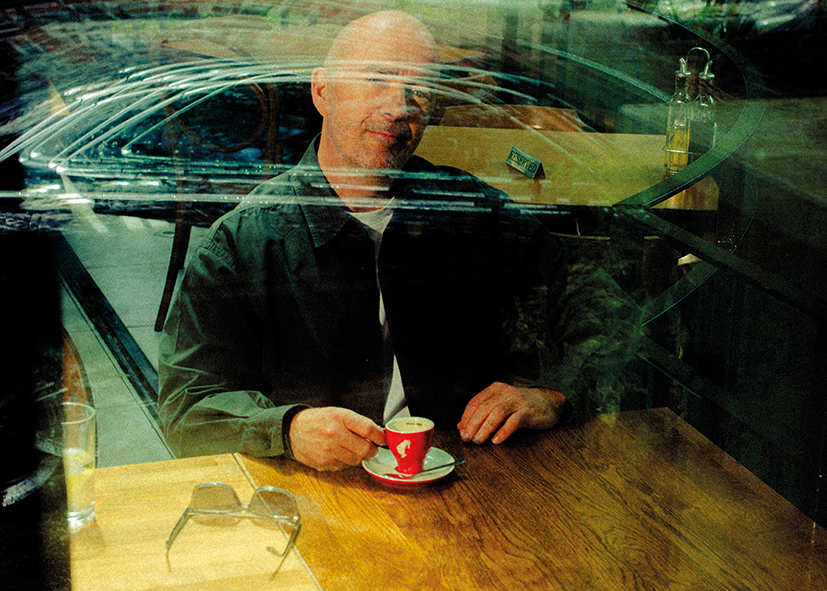
Richardson is best known as the former presenter of Channel 4’s Football Italia programme and former host of The Guardian Football Weekly podcast. He currently hosts BT Sport’s The UEFA Champions League Goals Show, World’s Strongest Man for Channel 5 and The Totally Football Show podcast. He is also employed by the Premier League, featuring in content related to Fantasy Premier League and for overseas-rights holders.
Mandatory credit:
Richardson’s verbal habits remain his source of appeal. In 2006, in the run-up to the World Cup, the Guardian asked if he would host a podcast. “I wasn’t really sure what that meant.” But he decided to give it a go.
The Italian league was in the doldrums. The greatest team, Juventus, had been relegated to Serie B for their involvement in match-fixing. By the time the plug was pulled on the diluted successor to the Channel 4 programmes, Richardson was the host of a football podcast for the Guardian.
Cox, who made frequent appearances, recalled, “It was again such a breath of fresh air. There wasn’t anything like it. A newspaper doing audio felt mad. And the fact they got James in was a really big step towards more intelligent football coverage.” After 11 seasons, Richardson and some colleagues left to create the Totally Football Show, which was bought by the Athletic in 2020. He is currently presenting a daily round-up throughout the (Italy-less) World Cup.
On his podcast, Richardson plays the role of a facilitator, but his approach remains one of breezy irony. He says things such as “woof”, “bingo”, “good Lord”, “crikey”, “gosh”, deploys a mixture of archaisms and lingo, fuses wordplay puns with historical and cultural references.
I attended the recording on 19 April, the afternoon Manchester City played Arsenal. Inchoate chatter developed into discussion points, and in the hour or so between the final whistle and going live, Richardson bashed out a script, including a witty – if unprophetic – opening that began, “Today: tête-à-tête at the Etihad leaves Arteta’s title hopes in tatters.”
He evoked a “premature explosion of Simmons”, to invoke a Tottenham player over-celebrating a goal that was soon cancelled out. Imagining the same goal from the scorer’s perspective prompted a rush of monosyllables: “I have shown you why I have been brought here.” Richardson exhibited his range of vocal and rhetorical tricks but also displayed a real desire for understanding. He wanted to know why a so-called supercomputer still had Arsenal as the title favourites. When he received a flippant answer, he doubled down.
Tom Williams, who was also in the booth, told me, “He’s always on it. He’s never morose or can’t be bothered to do the puns or find quirky ways into different subjects.”
Richardson, for his part, tends towards self-deprecation. When I described the recording as intense, he said: “I sat around and watched a football game with people who had opinions about it. I don’t do anything per se except be myself.” That’s an easy thing to take for granted. But it has been the common factor in his successes.
Richardson talks a lot about “serendipity” and good timing – how things have “always kind of worked out”. But the real beneficiary has been his audience. Talking to him and revisiting his body of work, I was reminded of how the playwright Tom Stoppard, using the generational plural, characterised Kenneth Tynan: “part of the luck we had”.
The Athletic’s podcast The Totally Football Show, presented by James Richardson, will be available daily throughout the Fifa World Cup 2026
[Further reading: World Cup tickets are a scandal]
Content from our partners
Related
Join the debate
Subscribe here to comment